What Is a Brow or Forehead Lift (Browplasty)?
A brow lift or forehead lift (also known as a browplasty) is used to alleviate wrinkles on the forehead and/or sagging eyebrows. Brow lifts are also ideal for reducing unwanted horizontal or vertical lines and wrinkles on the forehead, including frown lines or deep furrows between the eyebrows.
Do All Brows Need to Be Lifted? Or Is Brow “Shaping” More Important?
There is no “one size fits all” approach to brow lifting, so the answer depends totally on your unique facial features and underlying bone structure. Old-fashioned concepts in brow lift surgery stressed that all brows need to be lifted, but this is not necessarily an improvement for some people.
Recent innovations include the endoscopic brow lift – a procedure that has decreased the patient downtime but increased the number of brow lifts performed, with mixed results.
Depending on your facial features, more than 30% of the population shows an actual elevation in brow position as they age. This observation makes clear that not every brow should be lifted and that the overall shape of the brow, and position of the outside “tail” of the brow, is more important than the height of the brow on the forehead. Additionally, we may lose volume in key areas of the brow – this can be significantly improved by restoring volume with a natural filler such as your own body fat using the fat transfer technique.
In fact, less aggressive procedures aimed at improving the shape of the brow and restoring volume to the brow are a vast improvement over the old paradigm of simply raising the brows. As the position and shape of the brows are improved, you may also find that an additional procedure, such as an upper eyelid lift, may also assist in restoring the eyes to a youthful and fully rejuvenated appearance.
Brow Lift (Browplasty) – Recovery Timeline and Tips
Day One and Two Post-Op
We recommend that you take these first few days off to rest and recuperate.
Your brow lift will be performed as an outpatient procedure with general anesthetic or intravenous sedation with local anesthesia. If you have general anesthesia, you may experience some nausea. If so, please let your nurse know because there is medication you can take to feel better. Ideally, you should not be experiencing any pain or serious discomfort at all. But If you are, we recommend a mild over-the-counter non-opioid painkiller such as Tylenol.
Upon waking, you’ll notice that there is a light dressing over your brow area; this will be removed within one or two days. You may also have a drain tube in place to remove any excess blood or fluid; this helps reduce any swelling.
Detailed recovery guidance will be provided to help you rest comfortably and support proper healing after your procedure.
Recovery time will vary to a certain degree depending on the individual, but for most people of good health, any noticeable swelling or very minimal bruising will subside within the first few days.
The First Week
You may shower and wash your hair two to three days after surgery with a gentle soap that we will recommend. You may have some residual swelling or light bruising of the eye area. This should subside within the first week to 10 days.
Towards the end of the first week, you will return to your surgeon for your first post op appointment for the removal of any sutures (stitches).
The Next Few Weeks…
Three weeks after surgery, all swelling should have subsided. Any incision scars are typically not at all visible, but in any case, they are easily disguised by the hair or with makeup until finally healing occurs.
As healing continues, you’ll notice gradual refinement in your results, with progress that reflects your body’s natural recovery process.
Do You Really Need a Brow Lift? Or Will Something Else Work Better?
The brows are intrinsically connected to several key dynamic features in the forehead and eye area. It is an area of great muscular activity involving several key features, so it’s important to understand if a brow lift is indeed what you need — or if another procedure (or combination of procedures) will bring you better results. For example, you may instead need eyelid surgery (blepharoplasty) or a temple lift to achieve the result you’re looking for.
Another critical aspect of any brow-related surgery is the height of your hairline and forehead. Your surgeon will take into consideration how the brows are positioned in relation to the hairline and whether the hairline may also need to be lowered.
"I am now able to live my life and have the option to be who I am."
Watch success stories
“I just want to continue to navigate the word as me and continue to collect new experiences.”
Watch success stories
“To be able to know who I am is such an empowering experience.”
Watch success stories


How Do I Know If I’m an Ideal Candidate for a Brow Lift?
Your decision to have a brow lift (browplasty) or forehead lift is a highly personal one, and ultimately, your plastic surgeon should be able to give you the right advice and guidance based on your desired aesthetic outcomes.
Skin Condition and Quality
As we age, it’s only natural that the facial skin begins to lose elasticity and start to sag, and the skin around the eyes is no different. The corners of the eyes may develop crow’s feet. The eyebrows may start to sag downwards due to excessive skin. Fatty tissue may also gather either above or below the eyes. Vertical frown lines may appear between the brows, making us look ‘sad’ or overly serious. The forehead develops horizontal wrinkles and fine lines. If you have any of these issues, you may be an ideal candidate for a brow lift.
A brow lift removes the excess skin and fat, lifts the forehead and brow upwards, and smoothes out the skin. However, if you also have wrinkles around the eyes or sagging eyelids, you may also consider eyelid surgery (blepharoplasty) along with your brow lift.
For overall facial rejuvenation, to improve skin condition, you may also want to consider dermabrasion or microneedling, along with your brow lift, to improve overall skin quality.
Overall Health
As with any type of surgery, it helps to be in good overall health beforehand and be a non-smoker. If in doubt, please advise your surgeon of any preexisting medical conditions well in advance of surgery – it may make the difference between your ability to have a brow lift or opt for less invasive, non-surgical rejuvenation.
Ideal Age
Most of our brow lift candidates are between the ages of 40 and 65. But the procedure may be performed on younger patients who may have a genetic disposition to a heavy brow or deep “worry lines” between the brows.
Less Invasive, Non-surgical Alternatives to Brow Lifts
Before you consider a brow lift — or any other plastic surgery procedure — you may actually achieve your desired results with a less invasive procedure such as dermal fillers like Restylane®, Botox® and Dysport® injections, chemical peels, and/or facial dermabrasion. The science and techniques of various non-surgical facial rejuvenation procedures have improved greatly in the last few years, to the point that many people try these non-invasive techniques before considering a facelift.
FAQs About Brow Lift Surgery
- Does a facelift include a brow lift?
- How do I know if I need a brow lift?
- Is Brow Lift (Browplasty) Surgery Painful?
Facial Feminization Surgery: The Journey to Gender Affirmation
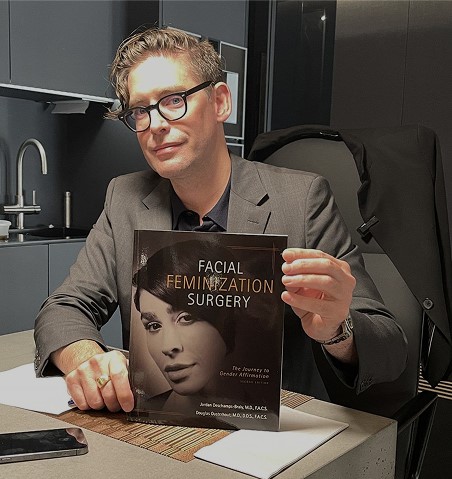
Dr. Deschamps-Braly’s book “Facial Feminization Surgery: The Journey to Gender Affirmation” is back and available now. This second edition covers advances in facial feminization, as well as helpful patient stories, and is a great resource for FFS patients and their loved ones.
Order Copy On Amazon




 Watch the truth unfold